Picking the right shed size might be the hardest part of the whole buying process. Most people walk in worried about buying too big. They picture a shed taking over the backyard, looming over the fence line, and decide to play it safe with something smaller instead.
After helping customers choose sheds for years, we can tell you that worry is almost always backwards. The calls we get later aren't from people who bought too much shed. They're from people who wish they'd gone one size up. We've had that conversation enough times that we'd rather bring it up before you buy than after.
This guide walks through how we actually think about shed sizing when a customer is standing in front of us. Not a formula, not a chart you fill out online, but the real questions and the real tradeoffs that come up every day on our lot in Columbus.
Why Shed Size Matters More Than You Think
An empty shed always looks bigger than it is. Walk into an empty 10x12 and it feels roomy, plenty of space to spare. Move in a riding mower, a few shelves, some totes of Christmas decorations, and the bikes nobody rides anymore, and that same building fills up fast.
This catches almost everyone off guard the first time. Floor space disappears the moment you start storing real things instead of imagining what might go where. That's one reason we ask people to think less about square footage on paper and more about what daily use is going to look like once the shed is actually full.
There's also a difference between space that's technically available and space you can actually use. A corner behind a mower is still square footage, but you're not going to squeeze a workbench into it. The number on the spec sheet tells you the footprint. It doesn't tell you how the building is going to feel once you're standing inside it trying to find the extension cord.
The Biggest Mistake We See Customers Make
The biggest mistake people make when buying a shed is only thinking about what they need to store today. Somebody comes in needing space for a mower and some tools, measures what they own right now, and buys exactly enough shed to fit it.
The problem is that storage needs don't stay put. People rarely think about what they'll own three, five, or ten years from now. A hobby picks up. The kids' bikes turn into kayaks. A push mower turns into a zero-turn. One thing we've learned over the years is that storage needs almost always grow. They almost never shrink.
Here's the part that tends to surprise people: the price difference between sizes is usually smaller than they expect. A slightly larger building often costs only a few hundred dollars more, but it buys years of extra usefulness. Spread that over the life of the shed and it's not much of a decision at all.
We see this play out with families the most. A couple buying their first shed for lawn equipment doesn't always think about the fact that in a few years there might be a boat, a second vehicle project, or a kid's dirt bike in the mix. We're not trying to sell anyone on things they don't need yet. We just want the building to still make sense five years from now, not just on the day it's delivered.
What We Ask Every Customer
When someone tells us, "I think I need a 10x12," we don't just nod and write it up. We ask questions first, because what people initially think they want and what actually fits their life are often two different things.
Some of the questions we ask almost every time:
- What exactly are you planning to store?
- Do you own a riding mower, or think you might get one?
- Any chance you'll own a golf cart or ATV down the road?
- Do you want shelving along the walls?
- Will you be working on projects in there, or just storing things?
- Could this shed turn into a workshop someday?
- Do you need room to walk around, or just room to stack?
Every one of those answers changes the recommendation. A customer storing garden tools and patio cushions needs a very different building than someone planning to keep a zero-turn mower and a workbench under one roof. We'd rather ask a few extra questions up front than have someone call us in a year saying the shed doesn't work anymore.
One conversation we have almost every day starts with someone describing what they own right now and ending with us asking what they think they'll own next. Most people haven't thought that far ahead when they first walk up, and that's fine. That's what the questions are for.
Measure Before You Decide
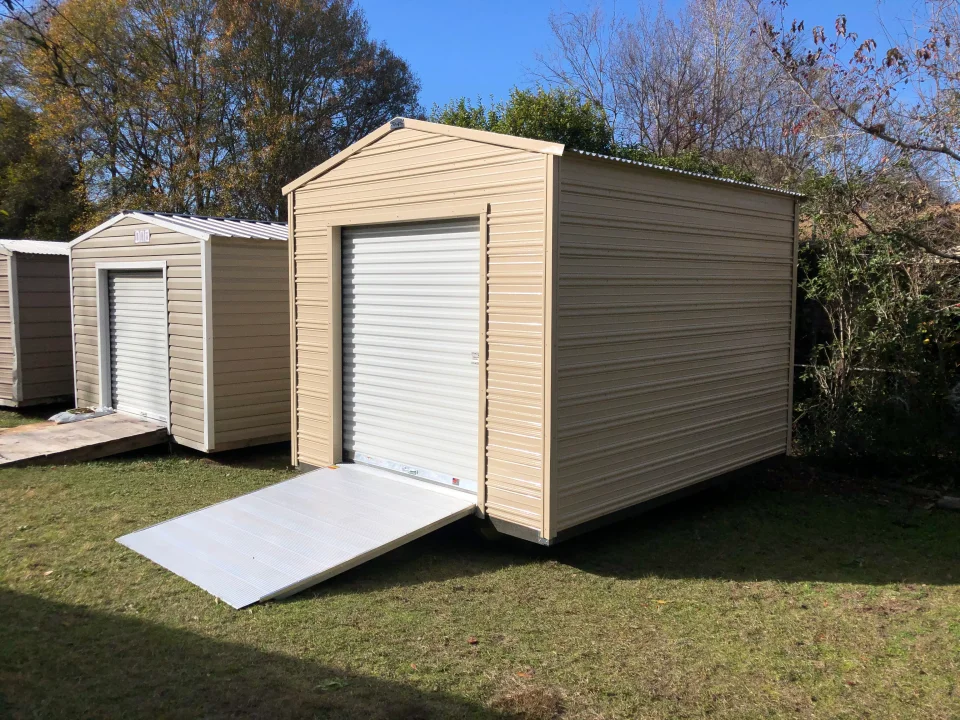
If you already have a specific piece of equipment in mind, measure it before you shop. A standard zero-turn mower usually runs 60 to 72 inches wide. A compact tractor can be narrower but considerably longer. A golf cart or ATV might look small in the driveway but still needs real clearance once it's parked next to shelving and a workbench.
Then add room to actually use the space. You want at least 12 to 18 inches on each side of a mower or cart to walk around it comfortably, and more than that if you plan to service it inside the shed. A building that's technically wide enough on paper can still feel tight if you're squeezing past equipment every time you go in for a rake.
Don't forget to check door width too. It's easy to size the building around what needs to live inside it and forget to confirm that same item can actually get through the door. If you're moving something wide in and out regularly, that measurement matters as much as the floor plan.
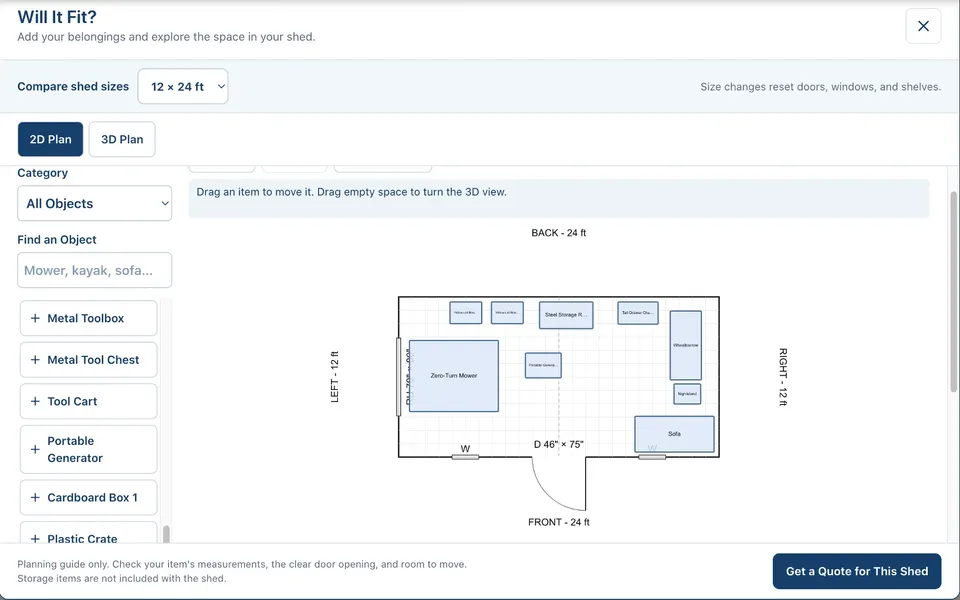
Once you have your measurements, you can check them visually. Our Will It Fit planner lets you arrange your belongings inside an aluminum shed's floor plan before you choose a size.
Common Items That Need More Space
Some items eat up more room than people expect when they're picturing the shed empty. Here are the ones we see most often:
| Item | Why It Needs More Room |
|---|---|
| Push mower | Small footprint alone, but needs clearance to maneuver in and out |
| Zero-turn mower | Wide turning radius means you need extra width, not just length |
| Golf cart | Roughly 4 feet wide and 8 feet long, plus room to walk around it |
| ATV | Compact but long, and usually stored alongside other gear |
| Side-by-side | Similar to a golf cart but wider, often calls for a 12-foot-wide building |
| Workbench | Needs wall space plus a few feet of clearance to actually use it |
| Shelving | Takes up floor space at the base even though it stores vertically |
| Bicycles | Multiple bikes add up fast, especially if they're not wall-mounted |
| Outdoor furniture | Cushions, tables, and chairs are bulkier than they look stacked up |
| Christmas decorations | Boxes and totes multiply every year and rarely get thinned out |
| Miscellaneous boxes | The easiest category to underestimate until moving day |
None of these items are unusual. They're what most of our customers are already storing. The mistake is picturing them one at a time instead of picturing them all together, in the same building, at the same time.
Add them up on paper and a 10x12 fills in faster than most people expect. Put a mower, a couple of shelving units, some totes, and a handful of bikes in there, and you've used most of the floor before you even get to the workbench you were hoping to fit in the corner.
Why Bigger Usually Pays Off
Moving up a size, say from a 10x12 to a 10x16, is rarely a dramatic jump in price. What it buys you is real: more floor space, more wall space for shelving, and room to add things later without running out of options.
We're not telling you to buy more shed than you'll ever use. We're saying that when you're stuck between two sizes, the extra cost of going bigger is almost always worth it over the years you'll own the building.
Think of it this way: you'll pay the extra cost once, up front, and get the benefit of it for as long as you own the shed. Buying too small means you either live with the frustration or end up shopping for a second building sooner than you planned. Neither of those is cheaper in the long run.
The Advice We Give Almost Every Customer
Almost every repeat customer tells us the same thing: "I wish I had gone one or two sizes bigger." We hear it often enough that it's become one of the first things we mention to new customers walking the lot.
It happens because people plan around what they can see in front of them right now. They don't picture the shed a few years down the road, once it's absorbed everything that no longer has a home in the garage or the attic. By the time they're back for a second building, they've already learned the lesson firsthand. We'd rather help someone learn it the first time around.
After helping customers choose sheds for decades, we've noticed the regret almost never runs the other direction. It's rare for someone to come back and say their shed was too big. It happens far more often the other way around.
Our Favorite All-Around Size
If someone asks us to just pick a size without knowing their full situation, we usually point them toward at least a 12x16 with 8-foot walls. It's not the biggest building we sell, but it covers more use cases than any other size on the lot.
The floor space is generous enough for a mower, a workbench, and general storage without feeling cramped. The taller 8-foot walls matter more than people expect going in. They give you room for shelving above eye level, so you're storing vertically instead of spreading everything across the floor. That combination, plenty of floor space along with real wall height, works well whether you're storing lawn equipment, running a small workshop, or just need somewhere to put everything that doesn't have a home anywhere else. It also leaves room to grow into, which matters more than most people realize when they're shopping on a Saturday afternoon.
That doesn't mean it's the right size for everyone. Someone with a small lot or a light storage need might do just fine with something smaller. But when we don't have a lot of specifics to go on, a 12x16 with taller walls is the size we come back to most, because it rarely leaves someone feeling boxed in a year later.
Don't Forget About Walking Space
Storage isn't only about whether things fit. It's about whether you can actually use the building once it's full. A shed packed wall to wall might technically hold everything on your list, but if you can't walk in and reach what you need without climbing over three totes, you're going to regret it before the first season is over.
Leave yourself a path. Leave room to open doors, pull equipment in and out, and move around safely. A building that's slightly bigger than you need and easy to use beats one that's exactly the right size on paper but frustrating every time you walk in.
This matters most for anyone using the shed year-round rather than just for seasonal storage. If you're only opening the door twice a year to grab the string trimmer, a tight fit is annoying but livable. If you're in there every weekend working on something, walking space stops being a nice-to-have and starts being the difference between a shed you enjoy using and one you dread.
Try Our Find My Shed Quiz
If you want a recommendation instead of guessing, try our Find My Shed quiz. Tell us what you're storing, how much room you want to work with, and whether you need workspace inside, and it'll recommend a size along with matching buildings we actually have in stock.
It's one of the fastest ways to get a straight answer instead of comparing a 10x12 against a 12x16 or a 12x20 on your own. A size that sounded plenty big on paper often looks tight once a mower and some shelving are accounted for. The quiz takes a lot of the guesswork out of the decision.
Final Thoughts
Choosing a shed size comes down to one shift in thinking: plan for where you'll be in a few years, not just where you are today. Almost every customer who buys one size larger than they originally planned tells us later it was the right call.
There's no single right answer for every property or every family. What we can tell you, after doing this for a long time, is that the sizing conversation is worth taking seriously before you sign anything. A few extra minutes thinking through what you actually own, what you're likely to add, and how you'll use the space day to day will save you a lot more than a few extra minutes down the road.
If you're not sure what you need, that's exactly what we're here for. Stop by Banner Buildings at 4011 Warm Springs Road in Columbus, browse our inventory, or request a free quote and we'll help you land on a size you won't outgrow.